You put your foot down to overtake, but the car has lost its usual pull. The engine warning light comes on, and a scan shows P0299. Does that mean the turbocharger has failed?
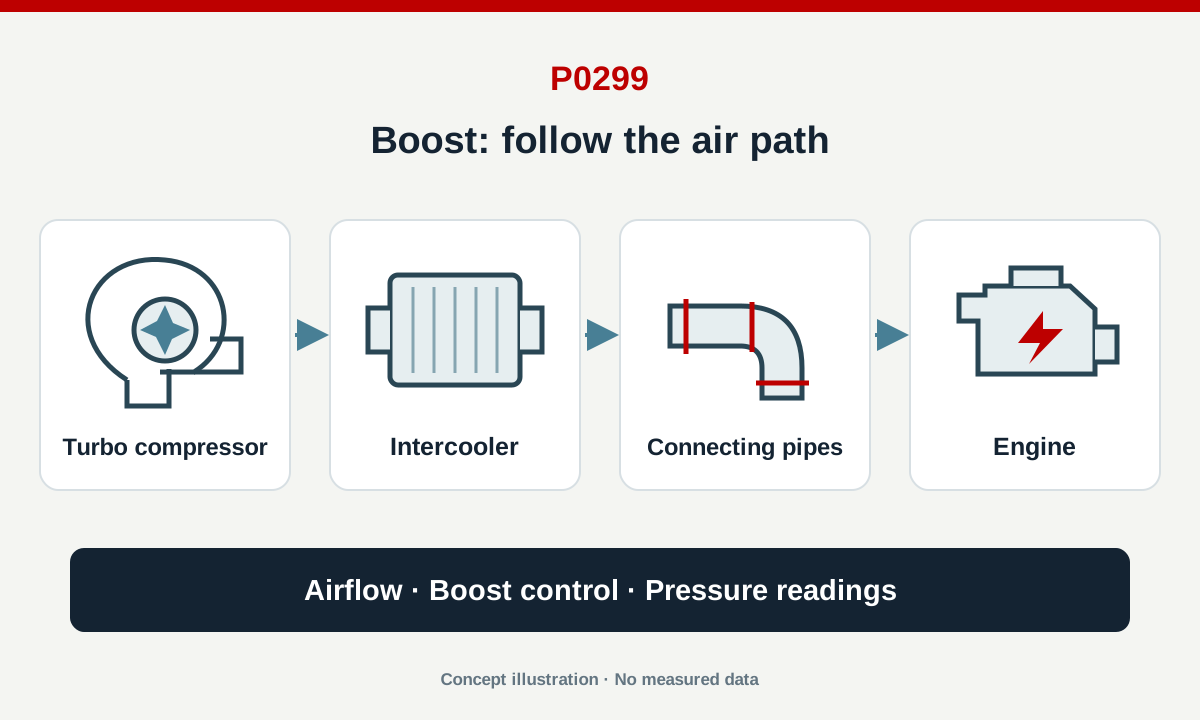
Not necessarily. P0299 generally means the boost pressure is lower than expected. It tells you what the engine management system has detected, not which part needs replacing. The turbo, charge-air pipes, intercooler, boost control and pressure sensors all have a part to play.
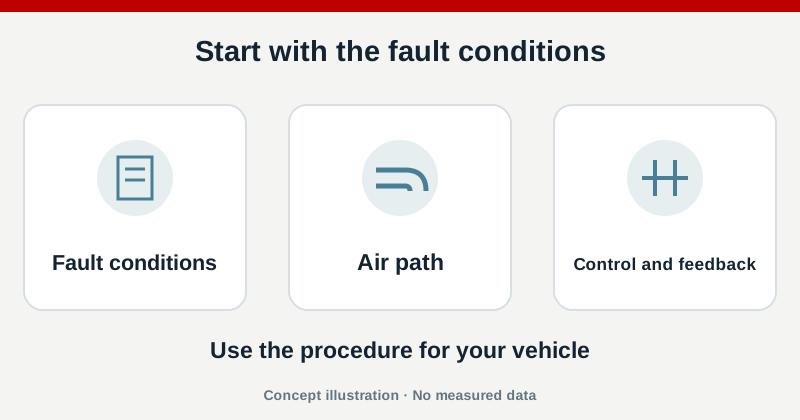
Find out when the boost falls short
A fault that appears during acceleration with a cold engine may need a different approach from one that occurs climbing a hill with a warm engine or under sustained load. Save all fault codes, their status and any freeze-frame data before clearing them. Note the engine speed, load and what the driver noticed when the problem occurred.
A technician compares requested and actual boost under the same operating conditions, using the vehicle's diagnostic procedure. Check the units and definitions first: absolute pressure and gauge pressure use different reference points. A few blips of the throttle in neutral, with little boost showing, do not prove that the turbo is faulty.
Check the route from the air filter to the engine
Air has to pass through the filter and turbo inlet, then the compressor, intercooler and connecting pipework. A restriction can limit airflow. On the pressurised side, a split hose, loose connection or leaking intercooler can let compressed air escape before it reaches the engine.
Some splits open only under pressure. A visual check cannot replace a leak test carried out to the manufacturer's procedure. Use the specified equipment, test pressure and isolation points; do not connect an air supply at an arbitrary pressure. Oil staining around a joint is worth investigating, but does not by itself prove that the turbo's oil seals have failed.
Check boost control and pressure readings
The control system depends on the engine. It may use a wastegate or variable turbine geometry, with a vacuum-operated or electric actuator. Identify the fitted system, then check the control command, vacuum or electrical supply, and actuator movement. An adjustment procedure for another model is not a general cure for P0299.
Pressure sensors and wiring also need checking. Confirm that the readings are plausible, and look for exhaust leaks upstream of the turbine or a restriction in the exhaust. The evidence should guide any inspection of the turbo itself. Do not adjust actuator rods, block control pipes or make repeated full-throttle runs to test a theory. Stop testing and arrange an inspection if there is a pronounced abnormal noise, heavy smoke or an oil-pressure warning.
After repair, safely recheck the conditions that originally triggered the fault, following the vehicle's procedure. Assess power delivery, requested and actual boost, and fault-code status. A smooth idle after clearing the codes does not confirm that boost is correct under load. Nor does a temporarily clear fault memory if the monitor has not yet run under the required conditions.
To look up guidance for your vehicle, select the exact model in Repair AI and enter P0299 with the symptoms, operating conditions, other codes and measured values. Make clear which details have not yet been checked.
Look up my vehicle