On a cold morning the engine turns reluctantly, sounding slower and heavier than usual. A jump-start gets it running, so the battery is declared worn out. That is worth investigating, but it is not yet a diagnosis.
A successful jump-start shows that extra electrical support or changed connection conditions helped. It does not prove the original battery is beyond use. Low charge, poor terminal contact, an engine ground problem or the starter itself can all produce weak cranking.
Is it turning slowly, or turning normally without starting?
This article concerns vehicles in which a conventional low-voltage battery and starter turn the engine. The reasoning does not apply directly to every hybrid or high-voltage starting system. Slow, uneven engine rotation differs from normal cranking without firing. A click with no rotation is another symptom to distinguish.
Note whether it happens cold, warm, after one night or after several days. Mention frequent short trips and long periods parked. Dimming instruments can offer a clue but do not measure battery health. If cranking voltage or charging condition has not been tested, do not assume it is normal.
Stored energy and delivered energy are different checks
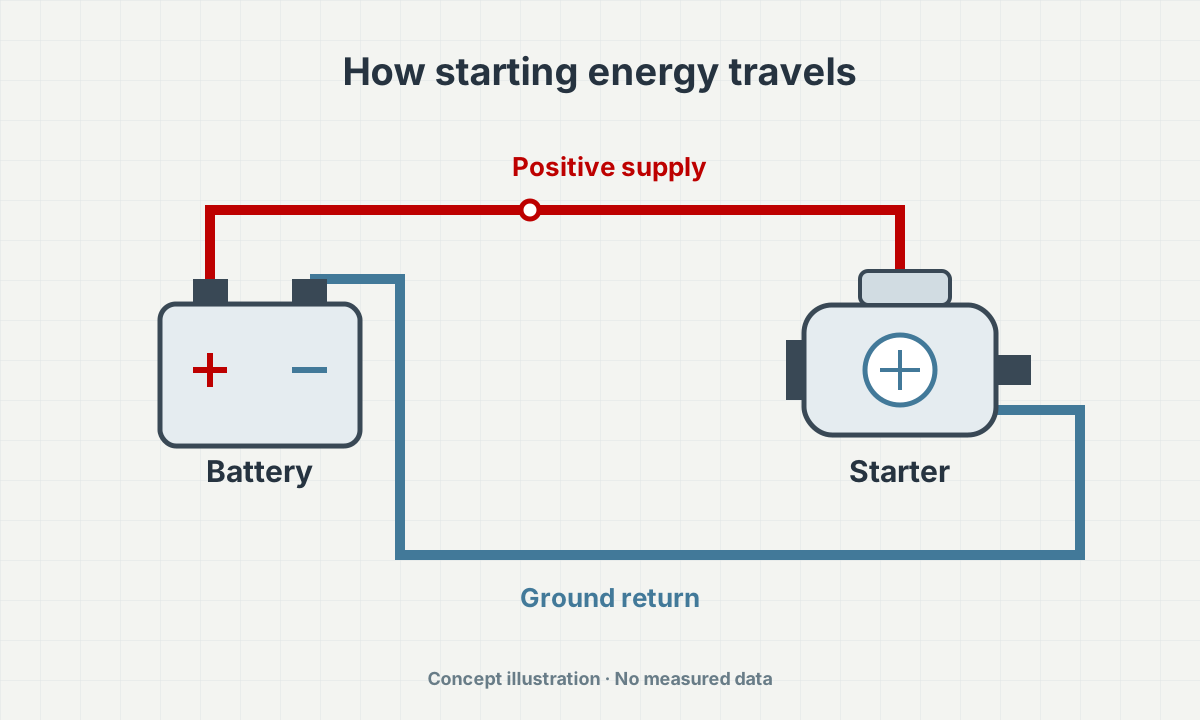
Starting requires high current. Even with charge in the battery, resistance in a positive cable, terminal or engine ground can prevent enough electrical energy reaching the starter. A connection may appear acceptable at rest and fail under starting load.
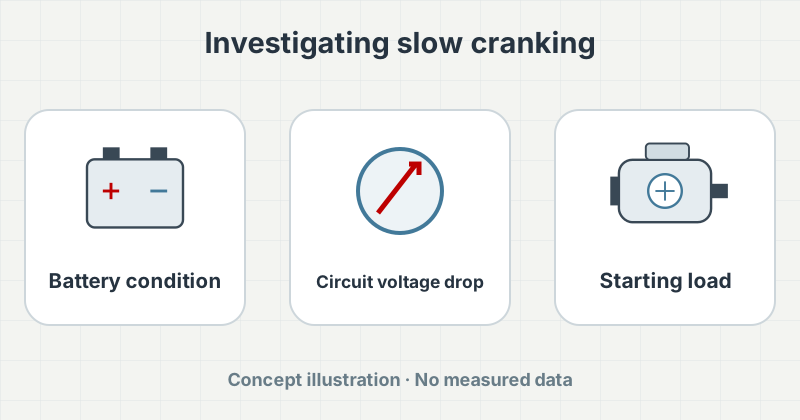
A technician can assess state of charge and battery health, observe cranking voltage, current and speed, and measure voltage drop on the positive and ground paths. A voltage-drop test locates losses while current flows; it is more than a resting-voltage reading. Interpret results for the battery type, temperature and vehicle rather than using one online threshold to order a replacement.
If charge is low, investigate usage, charging faults and abnormal draw while parked. One discharge does not establish permanent battery failure. Replacing the battery without finding the reason can leave the car struggling again days later.
Then consider the starter and mechanical resistance
If battery and circuit checks do not explain the symptom, inspect starter wear, internal faults and resistance to engine rotation. Unsuitable oil viscosity can add drag in cold weather. Check the specified oil and recent service details; do not choose thinner oil arbitrarily.
Avoid prolonged repeated cranking. Stop if cables become very hot, smoke or smell burnt. Follow the vehicle handbook for jump-start points, sequence and suitability, and never bridge starter terminals with a metal tool.
After repair, recheck starting after similar parking time and at a similar temperature, and confirm charging operation. If the battery discharges overnight again, investigate parked current draw using the vehicle procedure. One successful start is not enough verification.
In Repair AI, select your vehicle and explain whether it cranks slowly or cranks normally without firing, adding parking time, temperature and actual measurements to find relevant repair guidance.
Look up my vehicle